

Originally written by Teresa Canive.
Haz click aquí y lee la versión en español
The desert dust speck had many shapes. One day, it might take the form of an oval circle; the next, it could awaken to find itself as a thin sheet of paper. At times, it appeared as an immense mass of rubber, and without knowing why or for what purpose, it might see itself the following day as a small droplet of transparent water. It never repeated a shape, so it could never adopt a fixed name.
It had tried everything. It sought advice from the finest doctors in its land, consulted the brightest minds on its continent, and even travelled by kite to meet the greatest sages of its world. Yet no one had an answer.
One morning, it awoke in a form as delicate as a speck of desert dust. And so it was, on that day, it would be a tiny grain of desert sand. It had to tread carefully, if ‘treading’ could even describe its movements, because each step risked dissolving it into nothingness. It only had to survive for 12 hours, until it could safely rest once more in its protective glass bed.

After much thought, as it did daily, it decided to venture outside. That autumn day, the sky threatened a storm. A single raindrop could mean the end; it would never again take another form, vanishing without a trace. Why take such a risk?
The other beings it encountered greeted it enthusiastically, for this tiny desert speck carried the vital energy needed for the earth to spin, storms to form, and sunlight to shine. It was essential for maintaining life’s delicate balance. So why take such a risk? Well, here’s the answer.
This fragile and defenceless speck of desert dust was entirely responsible for sustaining life. But what kind of form bore such an important duty? Why did balance depend so heavily on a single, fragile shape? And yet, this is how the inhabitants of this remote world lived peacefully, watching their loved ones grow, laugh, cry, and dance through life.
Of course, the speck, which today resembled a grain of sand, had many protectors who had once vowed to keep it safe. They tried everything, from padded floors to enormous roofs shielding every step, preserving its light and exposure to life. But it was all in vain. Designing a perfect security system proved immensely complicated. Today, they faced a tiny and delicate speck, but tomorrow, it might be a massive, heavy mass.
Years ago, at one of the many conventions held to design a protection system for this life-giving force, a young boy raised his hand.
- “It seems,” he said, “that if we can predict the form it will take tomorrow, we could build a protection system each day that fits its next shape.”
Many nodded, convinced this approach could be the answer. While opinions varied, this idea steadily gained support.
One of the village’s wisest men, sceptical of predictions, responded,
- “Do you mean we must build, every night, whatever protection will safeguard tomorrow’s form?“
- “Exactly,” the boy replied. “We need to focus on developing a forecasting system that tells us what shape it will take next. Over time, we can improve it to predict further into the future. Plus, the protections we build can be reused for shapes we’ve already foreseen.”
The wise man wasn’t convinced. He felt a scream within him threatening to shatter the world’s delicate balance. Still, he trusted the boy’s enthusiasm and said,
- “Alright, we’ll try this prediction system to protect our precious life-giver. After all, it’s the most valuable thing we have, and we must do everything we can to preserve it.“
Immediately, voices of all pitches, high, low, loud, and soft, filled the room, creating a murmur of indistinguishable opinions. What was clear, however, was that half the population devoted themselves entirely to building the so-called Salvation System.
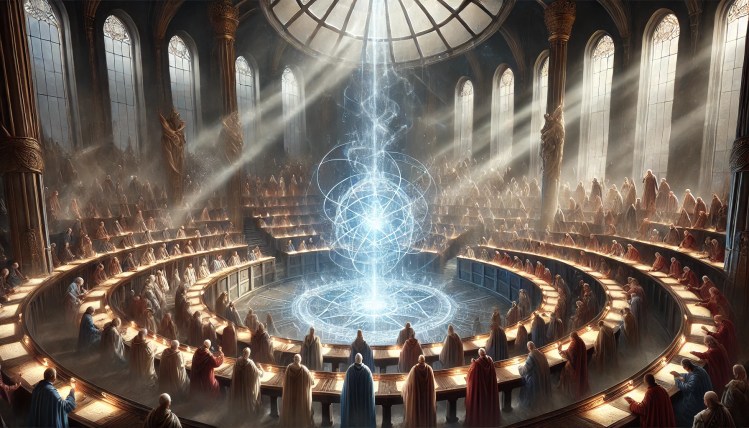
Years passed. Decades of effort, dedication, and hope followed. Many other stories might have ended with triumph: persistence rewarded, the goal achieved. But this is no ordinary tale.
Despite their hard work and countless sleepless nights, they never succeeded in developing a prediction system; not even one that could foresee the next minute.
And so, another convention was called, and the wise man spoke again:
- “We have tried night and day, for years, to create the impossible, wasting time and energy. I regret this failure, but I am glad we…”
At that moment, the boy who first proposed the prediction system interrupted,
- “We haven’t failed. Not at all. Over these years, we’ve worked tirelessly, spent resources, and made progress; even as we wept, stumbled, and screamed along the way. But it’s all led us to one realization.“
A hush fell over the crowd. Ears strained to hear every word. Just as hope seemed to vanish into the deepest darkest void, the boy finally spoke:
- “We pursued a longed-for solution, creating pressure that grew with the world’s expectations. Yes, we worked hard to reach it. But in doing so, we began to forget the very purpose of our protagonist: what today is a delicate petal. We forgot its reason for existing, the reason we breathe, drink, eat, sleep, and live. And we’ve come to this conclusion: What is the point of spending our lives chasing the impossible, trying to predict tomorrow, if we don’t stop to live and enjoy today Whether it’s a petal, an ocean, sand, or a massive form, it doesn’t matter. What matters is its purpose: to grant us the gift of living in the present moment. That is the true balance of life.”
And so, we reach the present day in this story. A day when the desert dust speck, the delicate petal, or the immense ocean continued to share its life-giving energy with the world.
The inhabitants lived each moment peacefully and gratefully, thankful for the chance to enjoy another day of life.

 Hi, I'm Teresa Canive